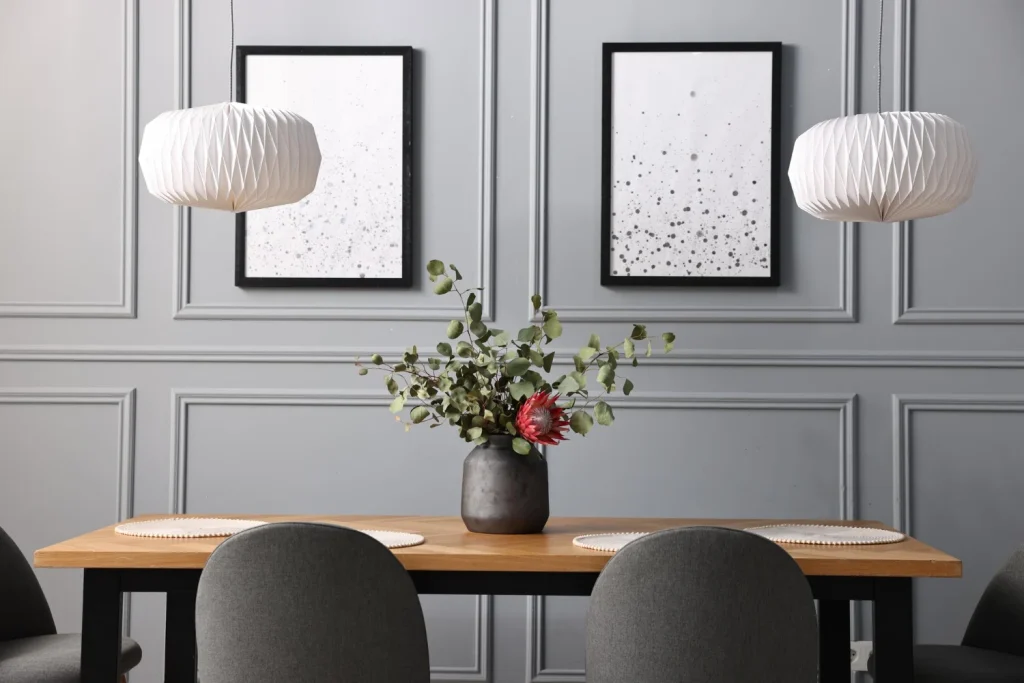
The dining room wall is one of the most important and most neglected surfaces in the home. People spend a lot of time in the dining room, sharing meals, hosting guests, celebrating occasions, yet the walls often end up with a single piece of art hung too high and not much else. Getting the wall decor right in a dining room changes the entire feel of the space, turning it from a functional room into one that actually makes people want to linger.
Here’s a look at what works, what doesn’t, and how to pull it off without overcomplicating things.
What Makes Good Dining Room Wall Decor?
Good dining room wall decor does two things: it relates to the scale of the room, and it creates a sense of occasion. The dining room is a room people typically enter for a specific purpose. The decor should amplify that feeling. A large single artwork above a sideboard, a gallery wall along one side, an architectural feature like wainscoting or a mural, all these choices signal that the room has been thought about.
Scale is the most common thing people get wrong. A piece of art that’s too small for the wall it’s on looks lost. As a general rule, large-format art and arrangements work better in dining rooms than smaller pieces, because the furniture in a dining room tends to be substantial and the art needs to hold its own against it.
Gallery Wall Ideas for Dining Rooms
A gallery wall along the main feature wall of a dining room is one of the most flexible and impactful options available. It allows for personal curation, works at almost any budget, and scales with the wall size.
A few things that make a dining room gallery wall work well:
- A consistent frame color or style, even if the art inside varies significantly
- A mix of sizes, with the largest pieces anchoring the center or bottom of the arrangement
- Varying the content slightly: photographs, prints, illustrations, and small mirrors can coexist if the frames unify them
- Hanging the arrangement so that the visual center sits at eye level when seated, not standing
That last point is worth pausing on. In a dining room, people spend most of their time seated. Art that’s hung at standard standing eye level can feel too high from the table. Try dropping arrangements by a few inches compared to where you’d hang them in a hallway.
For a step-by-step approach to planning and hanging a gallery arrangement, see this guide on how to make a gallery wall.
What to Put on a Dining Room Wall: Beyond Art
Artwork isn’t the only answer. Some of the most interesting dining room wall treatments avoid traditional framed art entirely.
Mirrors
A large mirror on a dining room wall does several things at once. It reflects light, visually doubles the perceived size of the room, and adds a decorative element with real functional logic behind it. An oversized round or arched mirror above a sideboard is one of the classic dining room moves for good reason.
Wainscoting and Architectural Wall Treatments
Wainscoting, applied wood paneling on the lower half of the wall, adds texture, architectural character, and a sense of formality that suits dining rooms well. It doesn’t require art because it is itself a visual treatment. Painted in a deep color with contrasting trim, it’s genuinely striking.
Board and batten and shiplap are related options at different price and effort points, creating similar architectural interest at lower material costs.
Wallpaper as a Feature Wall
A single wall of wallpaper in a dining room is one of the most transformative single changes possible. Botanical prints, geometric patterns, and textural grasscloth all work well, depending on the room’s style. The key is choosing a pattern with enough scale to read across the room rather than something that disappears into visual noise.
Modern Dining Room Wall Decor Ideas
Modern dining room wall decor tends toward fewer, larger elements rather than collections and arrangements. One oversized abstract print, a single large canvas, or a floating shelf display with minimal objects all fit this approach.
Materials matter in modern dining rooms. Metal-framed art, leather-wrapped frames, and art with strong geometric compositions all read as contemporary. Avoiding overly ornate frames and highly detailed figurative art keeps the tone consistent.
Dining Room Art Ideas: How to Choose
A few questions worth asking when selecting art for a dining room:
- Does it relate in some way to gathering, food, nature, or community? Not required, but these themes tend to resonate in a dining context.
- Does it have enough visual weight to hold the wall? Test this by holding the piece against the wall and standing back. If it looks small, it will look smaller once furniture is in front of it.
- Does the color palette connect to the room’s existing tones? Art doesn’t need to match, but it should have at least one color relationship to the room.
Small Dining Room Wall Decor Ideas
In a smaller dining room, scale down but don’t abandon ambition. A single strong piece is better than an overcrowded gallery. A vertically oriented print or mirror elongates the space visually. Avoiding too many competing visual elements keeps the room from feeling tight.
A ledge shelf at picture-rail height with a handful of leaning prints offers a flexible alternative to hanging, useful in rooms where wall damage needs to be minimized (rental dining areas, for example).
For additional reference on managing wall space in smaller rooms, see these small bedroom wall and layout ideas which cover many of the same compositional principles.
Formal Dining Room Wall Decor
For formal dining rooms, the decor can carry more weight and drama. Large oil-style paintings, floor-to-ceiling wainscoting, dark wallpaper, and ornate framed mirrors are all in play. The goal is a room that feels distinct from everyday spaces, a room that has ceremony.
A statement light fixture paired with a bold wall treatment creates a room that needs very little else. The combination of dramatic overhead light and a textured or colored wall does most of the work.
Shower tile and material choices offer some parallel thinking around how pattern and texture transform a room. See brilliant shower tile ideas for reference on how large-format patterns work in residential spaces.
What This Means for Your Dining Room
Dining room walls deserve deliberate attention because this is a room where the ambiance actively shapes the experience of being in it. A beautiful meal feels different in a room with considered walls than in a room where the walls were clearly an afterthought.
Start by identifying the primary wall, usually the one most visible from the entrance or the one behind the main seating. Give it the most attention. Once that wall has a strong anchor, the others can be simpler. Not every wall needs a treatment. But the main one should say something.