A small entryway doesn’t have to be a bottleneck. With the right combination of wall storage, multi-purpose furniture, and a bit of restraint in the decor department, even a narrow hallway or apartment entry can pull double duty: welcoming visitors in and keeping your household running smoothly. The key is knowing which solutions actually earn their square footage.
Most people treat the entryway like a dumping zone. Shoes pile up, bags hang everywhere, and keys disappear. The problem usually isn’t the size. It’s the lack of a system.
Why Does the Entryway Feel So Chaotic?
Because it handles the highest-traffic moments of your day: coming in and going out. Everything you need ‘just for a second’ ends up living there permanently. A coat you meant to put away. School bags. Packages. Umbrellas that breed in corners.
Counterintuitively, more storage isn’t always the fix. Sometimes the issue is that items don’t have a designated spot. When everything has a home, the clutter practically solves itself.
What Are the Best Small Entryway Storage Ideas?
The short answer: vertical storage, multi-use furniture, and wall-mounted organizers. These three categories solve most small entryway problems without eating up precious floor space.
Wall-mounted hooks and shelves free up the floor entirely. A floating shelf at eye level gives you a landing spot for keys and mail without taking up an inch of usable ground. Add hooks below it and you’ve got a coat system that cost maybe $40 and took an afternoon to install.
The American Society of Interior Designers (ASID) consistently points out that vertical space is one of the most underused dimensions in small rooms. In an entryway, this is especially true. Most people stop thinking at around five feet high, but storage potential runs all the way to the ceiling.
Wall-Mounted Options Worth Considering
- Floating shelves with a small lip to keep items from sliding
- Pegboards with interchangeable hooks and small baskets
- Entryway organizer wall panels with hooks, a shelf, and a key holder built in
- Slim wall-mounted coat racks with folding hooks to save depth
How Do You Make a Narrow Entryway More Functional?
Narrow entryway storage works best when you think in layers. The floor layer handles shoes. The mid layer (waist to shoulder height) handles bags and daily items. The upper layer stores seasonal gear.
A narrow entryway bench with shoe storage underneath is probably the single most efficient piece of furniture you can put in a tight space. You get seating for putting shoes on, concealed shoe storage, and a surface for bags, all in one footprint that’s often no wider than 18 inches.
If floor space is really limited, a wall-mounted drop-leaf bench is worth looking at. It folds flat when not in use, freeing the entire floor. It won’t hold as much weight, but for a solo apartment or couple, it works well.
Small Apartment Entryway Ideas: What Changes?
Apartment entryways often have one extra constraint: you can’t always put holes in walls, or the landlord has rules about what you can attach. That changes the approach a bit.
Command strips have come a long way. For lightweight hooks and small shelves, they hold up fine in most cases. Freestanding furniture becomes more important here: a slim hall tree or a leaning ladder shelf gives you vertical storage without any wall damage.
Another thing that changes in apartments: the entryway is often shared with another function. It might be the edge of your living room, or right next to the kitchen. In those cases, consistency in materials and color between the entryway and the adjacent space makes the whole area feel intentional rather than tacked on. You might want to look at some
You might also want to consider small bedroom layout approaches when thinking about how to use tight residential spaces efficiently, since many of the same principles apply.
Shoe Storage Ideas for Small Entryways
Shoes are usually the biggest offender. They take up floor space, they multiply, and nobody wants to look at a pile of sneakers when they walk through the door.
A few approaches that work in tight spaces:
- Over-the-door shoe organizers use space that’s otherwise wasted
- Floating shoe shelves mounted low on the wall keep them visible but contained
- A closed shoe cabinet with a thin profile (around 10-12 inches deep) hides everything and doubles as a console
- Stackable shoe boxes for seasonal rotation, stored in a closet or upper shelf
The rotation approach is underrated. You don’t need every pair accessible at once. Keep what’s current in the entryway, store the rest. It sounds obvious, but most people don’t do it.
Entryway Bench and Coat Rack Ideas for Small Spaces
The bench-and-hooks combo is the classic small entryway solution for a reason. It’s functional, it reads as furniture rather than storage equipment, and it works in almost any style.
For small spaces, look for:
- Benches with open cubbies rather than solid bases, which visually lighten the piece
- Wall-mounted bench units rather than freestanding, saving 2-4 inches of depth
- Coat racks with adjustable hooks so you can configure them for your household’s actual coat situation
If you want something that functions as a real design moment, a wood hall tree with a mirror, hooks, and a bench can anchor the whole space. Just measure carefully. A piece that’s too large will close off the entry instead of opening it up.
Entryway Decor: How Much Is Too Much?
Here’s the thing. Small entryway decor walks a fine line. You want the space to feel welcoming, not clinical. But in a tight spot, every decorative item competes with function.
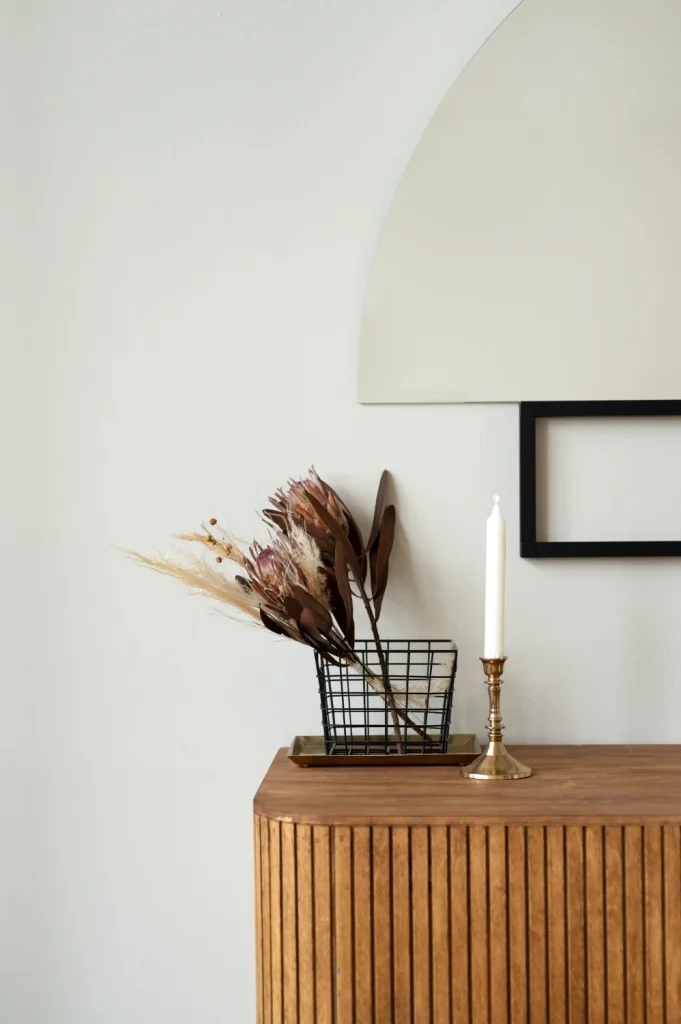
The rule of thumb from most interior designers: one to two decorative elements, maximum. A small plant, a framed print, or a mirror. That’s usually enough. The mirror does double duty since it makes the space feel larger while also being genuinely useful.
For more inspiration on how accent elements can transform a tight space, see this guide on accent wall ideas that work in compact rooms.
Speaking of mirrors: placing one directly across from or near the door is the oldest trick in the small-space book. It bounces light and visually doubles the depth of the entry. Works every time.
Entryway Mail Organizer and Daily Essentials
Mail is one of those things that seems harmless and then suddenly covers every surface. A wall-mounted mail organizer with labeled slots for incoming, outgoing, and to-be-filed keeps the paper situation under control.
Same goes for keys. A dedicated hook near the door is a tiny intervention that saves an average of several minutes every morning. Small thing. Surprisingly impactful.
Other daily essentials worth giving a home in the entryway: sunglasses, reusable bags, dog leashes, headphones. Anything that lives in the ‘grab it on the way out’ category. If it doesn’t have a spot, it will end up on the floor.
Minimalist Entryway Ideas: Less Really Is More
Minimalist entryway design doesn’t mean spartan or cold. It means intentional. Every element earns its place by function, by beauty, or ideally both.
In practice, this looks like: one bench, one coat rack, one shelf, and nothing on the floor except what absolutely can’t be stored elsewhere. Clean lines, neutral colors, and storage that conceals rather than displays.
Minimalism is especially effective in small entryways because visual clutter amplifies the sense of smallness. Fewer things, better quality, better placement. The space feels bigger and calmer.
Where Things Stand
Small entryway ideas work best when they address three things at once: where things live, how the space looks, and how it flows. A system that handles coats, shoes, and daily items without crowding the floor will solve most of the problems.
The best small entryway setups aren’t usually the ones with the most storage. They’re the ones where every square inch is thought through. A wall hook in the right place. A bench that fits the width exactly. A mirror that opens up the view.
Start with the items that create the most chaos, build a home for those first, and go from there. The rest tends to follow.